
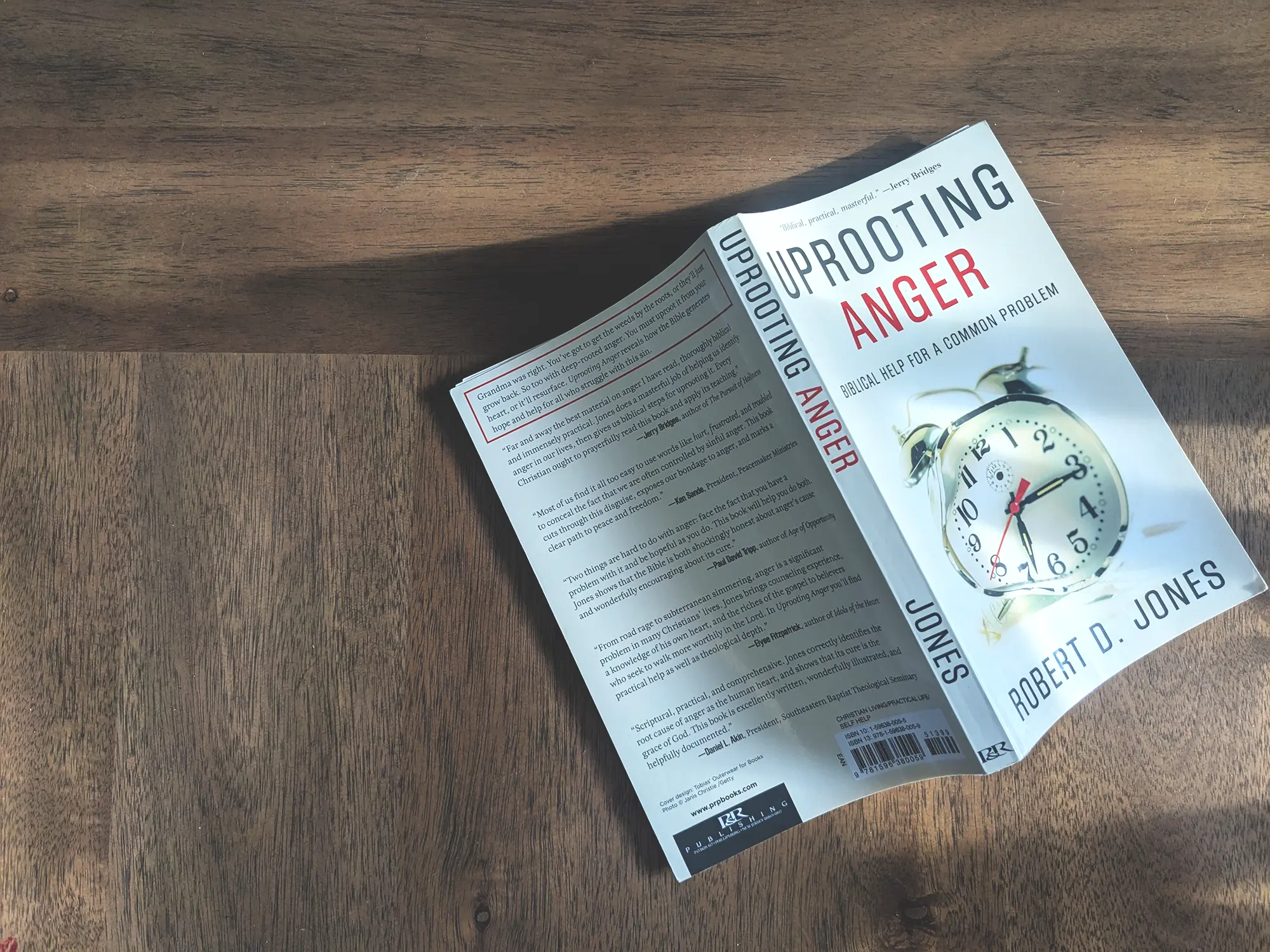

Effectively get to the root of anger—and chart a biblical course for heart change.
This is my go-to book when counseling anger issues.
Anger is something we all deal with, but few of us would acknowledge that we have an anger problem. “I’m just irritated,” we say. “Let me vent for a minute, then I’ll be fine. After all, what they did to me was wrong, and it’s important to for me to be honest with myself as I process this.”
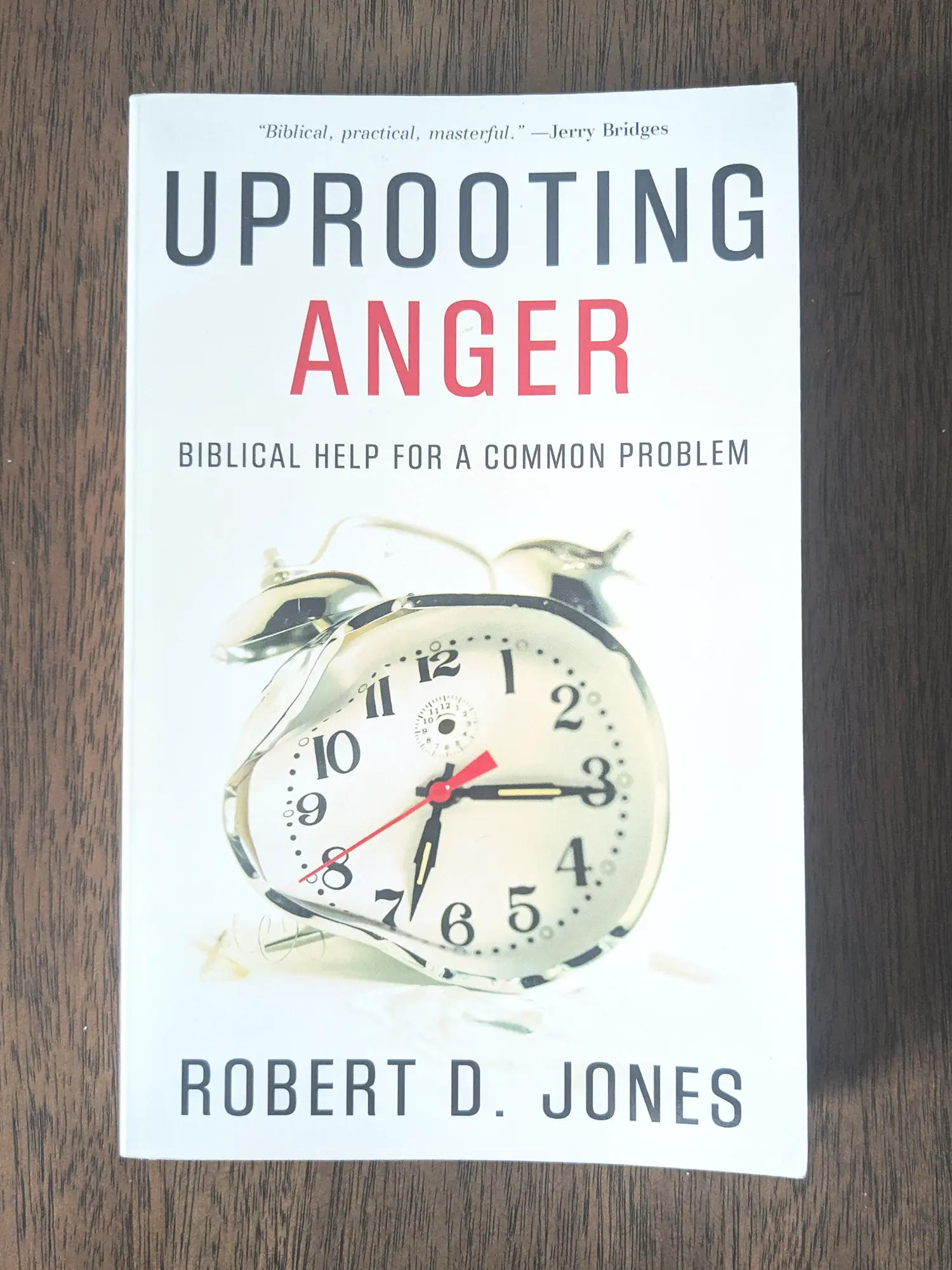
Affiliate Link
If you’ve ever heard this in the counseling room—or said something like it yourself—then Uprooting Anger is for you.
In ten balanced chapters, pastor, seminary professor, and counselor Robert D. Jones defines anger biblically, challenges the counselee’s view of himself, draws out the heart issues, and lays out the path to repentance.
(Stick to the end for a free study guide, including counseling homework assignments.)
Key Takeaways: A Biblical Counselor’s Cheat-Sheet for Dealing with Anger
Definition: “Our anger is our whole-personed active response of negative moral judgment against perceived evil” (p. 15).
Obstacle: Angry people are self-deceived, so counselors must help remove the veil of self-deception. Jones does this, in part, by providing three biblical criteria. Righteous anger:
- Reacts against actual sin
- Focuses on God and his concerns, not on me and mine
- Is accompanied by other godly qualities (p. 29)
This study begins to expose the angry person’s sinful anger to themselves, which is the first step in leading them to repentance.
Response: Jones notes that the proper response to this awareness is repentance, “not only of the anger itself, which we now discover to have been sinful anger, but also of our self-deceived justification of it in the name of ‘righteous’ anger” (p. 39).
Getting to the heart: The angry person must understand why they are angry. Statements like, “All I want…” or “If only I had…” (p. 45) are good indicators of what they are coveting (treasuring, worshipping, desiring, etc.) in their heart. Sometimes this is a sinful object, but I’ve found that more often anger arises because “it is possible to desire a good or legitimate object too much” (p. 51).
Why we fail to change: Too often our focus is, Stop ______ [bad thing], do _____ [good thing] instead. We may be able to stop the bad thing and do the good thing for a time, but it never lasts because we fail to address the heart motivation (p. 64). Our primary response can’t be stop bad, do good but instead must be repent of our angry heart desires (p. 65). Particularly regarding the good things that we love too much, we must “repent, not of the desire itself, but of the rulingness of the desire” (p. 71). We can only do this in dependence on God’s enabling grace (p. 65).
Ways anger is manifested: Jones provides two broad categories, sinful revealing and sinful concealing. The angry person will choose to reveal or conceal their anger because they believe it will help them get what they want. Sinful revealing (chapter 5) often corresponds to sins of commission, while sinful concealing (chapter 6) often corresponds to sins of omission.
Anger at God: “Anger is a function of our judgment. We perceive something or someone to be wrong, and we respond accordingly with our whole being. Framed this way, the answer to our ‘Is it okay to be angry with God?’ question is clear: No! Anger against God is wrong because it accuses God of wrongdoing” (p. 115). Jonah 4 is instructive here (see p. 117-118). The solution to anger at God involves trusting his sovereignty, faithfulness, and goodness, and moving towards him in humility, prayer, lament, and trusting obedience (p. 122-126).
Anger at self: Jones identifies five ways the Bible addresses self-anger. The person who is angry with himself may be…
- Unable or unwilling to receive God’s forgiveness (p. 131)
- Unable or unwilling to see his own sinfulness (p. 133)
- Venting at failure to obtain an idolatrous desire (p. 133)
- Live under his own standard of righteousness (p. 135)
- Convinced that he is his own judge (p. 136)
The solution: “We must confess the deceptiveness and power of our ruling desires, and repent of their rulingness. In humble faith we meet a forgiving Savior, and in his strength we dethrone those idols and learn to rest in him” (p. 134-135).
A Brief Review
Uprooting Anger is a title that should be in every counselor’s toolkit. It covers ground familiar to most biblical counselors, but let me be clear: Unlike many of the counseling books published today, which are solid but tend to repeat the same information derived from Adams and Powlison and Mack, Jones communicates the basics of biblical counseling in a fresh way.
He skillfully applies these basics to the problem of anger, providing insight to the counselee and counselor alike. He writes with a winsome, readable, experienced voice. The chapters are short enough for anyone to read yet long enough to develop his ideas. The end-of-chapter application questions are helpful, as are the assignment-filled appendices. Every page is thoroughly biblical.
Most importantly, I have seen it used by the Spirit many times to help open a counselee’s eyes to the depths of their problem.
You will be hard pressed to find a better book on anger to give to your counselees (or read for yourself!) that this one.
Study Guide & Counseling Assignments
I’ve created a study guide with weekly counseling assignments for each chapter that will help your counselee walk through this book.
Get it here:
