
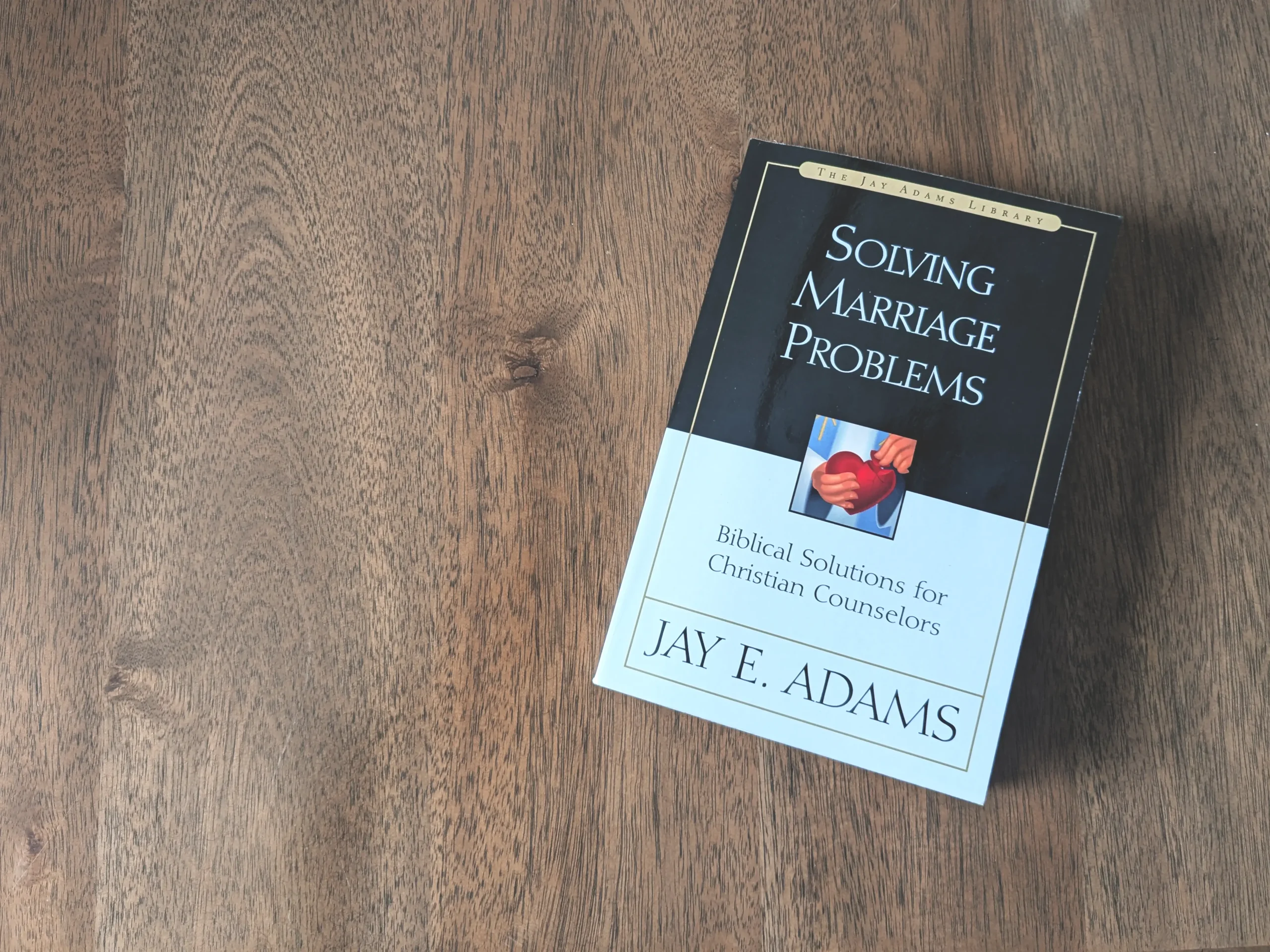

Jay Adams had a wonderful way of cutting straight to the heart of a problem. While his language and examples are a bit dated (this book was published in 1983), his works are still relevant, pithy, and profound. He covers more ground in a mere 120 pages than many other marriage counseling books do in 300 or more.

Affiliate Link
Solving Marriage Problems is required reading for the ACBC Marriage Specialization training. That was enough of a recommendation for me to pick it up, and my concurrence probably won’t impact your decision to read the book or not (but you should).
Rather than writing a traditional review, I will summarize the most important diagnoses and prescriptions that Adams gives. This overview can serve as a reference sheet for your marriage counseling, but again: Please read the book to get the full effect!
Get a free two-page printable summary of this material below.
Call Sin, Sin
Biblical counselors must not label everything as sin. Our first responsibility is to God—if he calls something sin, we must call it sin, too. “Our zeal for ripping off modern labels and replacing them with ‘sin’ is due to persistent efforts by others to substitute some modern misleading term for that biblical label” (p. 13).
If something is not sin, we are equally obligated to call it not sin. But, human nature being what it is, the problem is generally one of failure to call sin, sin. “The difference in labeling leads to a difference in thinking about the problem, which, in turn, leads to a different solution and ultimately to a different outcome. What begins by sounding kind [e.g., “calling drunkenness a ‘disease’ or a ‘sickness’ rather than a ‘sin’,” p. 13] ends up destroying hope” (p. 14).
Construct a Biblical View of Marriage
Even professing Christians who have spent their entire lives in the church can ingest the world’s perspective on marriage. Here are some important correctives:
- The origin of marriage is divine (p. 18). Find out how your counselees view marriage. Do they understand not only the divine origin of the institution of marriage (Genesis 2:22-25)—which is not something that you can assume they understand—but also the divine origin of their particular marriage? “What therefore God has joined together, let not man separate” (Matthew 19:6).
- The purpose of marriage is companionship (p. 20-21). God indicates this when he said, “It is not good that the man should be alone; I will make him a helper fit for him” (Genesis 2:18; c.f. Proverbs 2:16–17; Malachi 2:14). The essence or purpose of marriage is more than procreation, which is why a marriage still exists even if one or both spouses is infertile, physically unable to have sex, sterile, of advanced age, etc.
- The obligation of marriage is to provide companionship (p. 22-23). In this regard, Adams says that the fundamental question for each husband and wife to understand is, “‘How can I please God and my mate?’ not ‘How can I please myself?’ To please God by rightly pleasing one’s spouse is the basic obligation of marriage” (p. 23). In other words, “How am I meeting my spouse’s need for companionship?”
- The commitment of marriage is binding (p. 23-26). Adams calls marriage “a final act” (p. 24). Your counselees must understand the binding nature of a biblical covenant, for the covenant of marriage is a depiction of God’s covenant with us in Christ (Ephesians 5:32).
Correct Unbiblical Concepts
- A wrong idea of love (p. 27-32). The biblical concept of love must be distinguished from the world’s idea of romantic love. As important and beautiful as romantic love is, that cannot be the basis of the marriage. Rather, “Love in the Bible begins with giving. Love is the giving of yourself for another; it is giving your time, your interest, your thought, your consideration, your money, your creativity, or even your very life. When one regularly gives himself to another, he deposits a ‘treasure’ in that other person, and that is where his ‘heart will be also'” (p. 29). Adams notes that the traditional wedding vows got it right in asking “will you love…” not “do you love…” (p. 30). Love is a commitment to give yourself for the sake of the other.
- I am the same person after marriage as I was before (p. 32-33). “Marriage is a commitment to become a new person” (p. 33). Because of the great mystery of two becoming one, the two individuals are changed at an essential level and cannot have the same priorities as they did when single because they are not the same person as when they were single (p. 32).
- The way we “click” (or feel, or work) together is more important than sharing the same faith (p. 33-34). The one-flesh union cannot happen if one person is united to Christ and the other is not. “Unbelief allied with belief in Christ means just one thing—there can be no real intimacy in matters that really count” (p. 34). This is an important issue to cover in singles discipleship and pre-marital counseling.
Confront Communication Breakdowns
“The communication breakdown that occurred when Adam sinned had both a vertical and a horizontal dimension” (p. 41). Therefore, “In order to establish or reestablish communication in intimacy, it is first necessary to eliminate the sin that is blocking communication” (p. 42). Adams is saying that the root cause of all communication problems is sin.
Whatever the specific sins may be, as a counselor you can be confident that selfishness or a self-centered way of thinking and living is at the root. Love, after all, “does not insist on its own way” (1 Corinthians 13:5). Conflict grows in marriages where self-centered living has replaced others-centered love. “No wonder sinners have so much difficulty in marriage: Its very design—that of living for someone else to make him or her happy and meet his or her need for companionship—is contrary to sinful human nature” (p. 48-49).
These problems will often materialize around certain recognizable spheres. Adams lists (chapter 8):
- Lack of discipline
- Money problems
- Blame shifting
- Wrong priorities
The counselor’s objective will be to confront failure in each of those areas by helping the couple recognize the sinful root, humbly turn to Christ for heart change, and replace old (selfish) ways of living with new (biblical) ways of living.
Additionally, there are particular relationships that often fuel conflict. These include (chapters 10 and 11):
- In-laws
- Children
- Former spouses/exes and shared children
- Workplace influences
- Friendships (particularly envy; Adams mentions “keeping up with the Jones” whether it is big house, vacations, a seemingly great relationship, etc)
The counselor must carefully inquire about each of these areas to determine which may be harmfully impacting the marriage relationship. We will always imitate something (p. 62). “Don’t imitate evil, but imitate good” (3 John 1:11). Cut off harmful or tempting relationships and surround yourselves with people who will build up your faith.
Counter False Solutions
Counselees are often convinced that there is an easy way out of their marriage problems.
- Making the best of a bad situation. “They hope for too little and are willing to settle for less than the biblical solution to their problem” (p. 98).
- Endure or end the marriage. This perspective fails to grasp biblical hope and doubts God’s ability to work change.
- I must wait for my feelings to return or follow my feelings elsewhere. This is often expressed as, “I no longer have feelings for him/her.” The unstated assumption is, “and therefore there is nothing to be done but… [endure, leave, or pursue the person I do have feelings for].”
- It’s not that serious. Adams notes that, for the one who does not recognize that sin abounds, he will not know that grace abounds (p. 101).
- Time will heal. This non-solution “proposes to solve problems by ignoring them” (p. 102).
- There’s no problem. Sometimes one spouse will say this regarding his spouse’s concerns. Simply point out that if they can’t agree on whether or not there is a problem, then they clearly have a serious communication problem (p. 103).
- Separation for a time. “You simply can’t put two people together by tearing them apart. The two must work together to solve their problems God’s way, but they cannot do that if they are allowed to separate” (p. 103). Of course, we are quick to add that there are dangerous and violent situations in which one person must flee for safety. But the principle remains: There is no healing through separation.
Construct Biblical Solutions
In chapter 15, Adams summarizes the “basic aims” of marriage counseling in, which are:
- To secure a commitment from both parties to Christ and to His Word as the standard for all that is done and said,
which will - Foster and establish companionship between them, understood to be the essence of marriage,
leading to - Unity in intimacy,
which exhibits - Growth,
and which - Exemplifies the relationship between Christ and His church.
This book is a phenomenal tool to keep your marriage counseling focused on identifying problems and pointing people towards biblical solutions. Please read the book for yourself, and make use of my two-page printable summary, which is perfect for putting in your counseling reference binder.
