
Few counselees are in the habit of studying the Scriptures. For some, Bible study is daunting because they think they need to become an expert first. For others, it is because they simply don’t know how.
I developed this method to help my teenage children learn to study the Bible verse-by-verse in a thoughtful, rigorous, yet highly doable way.
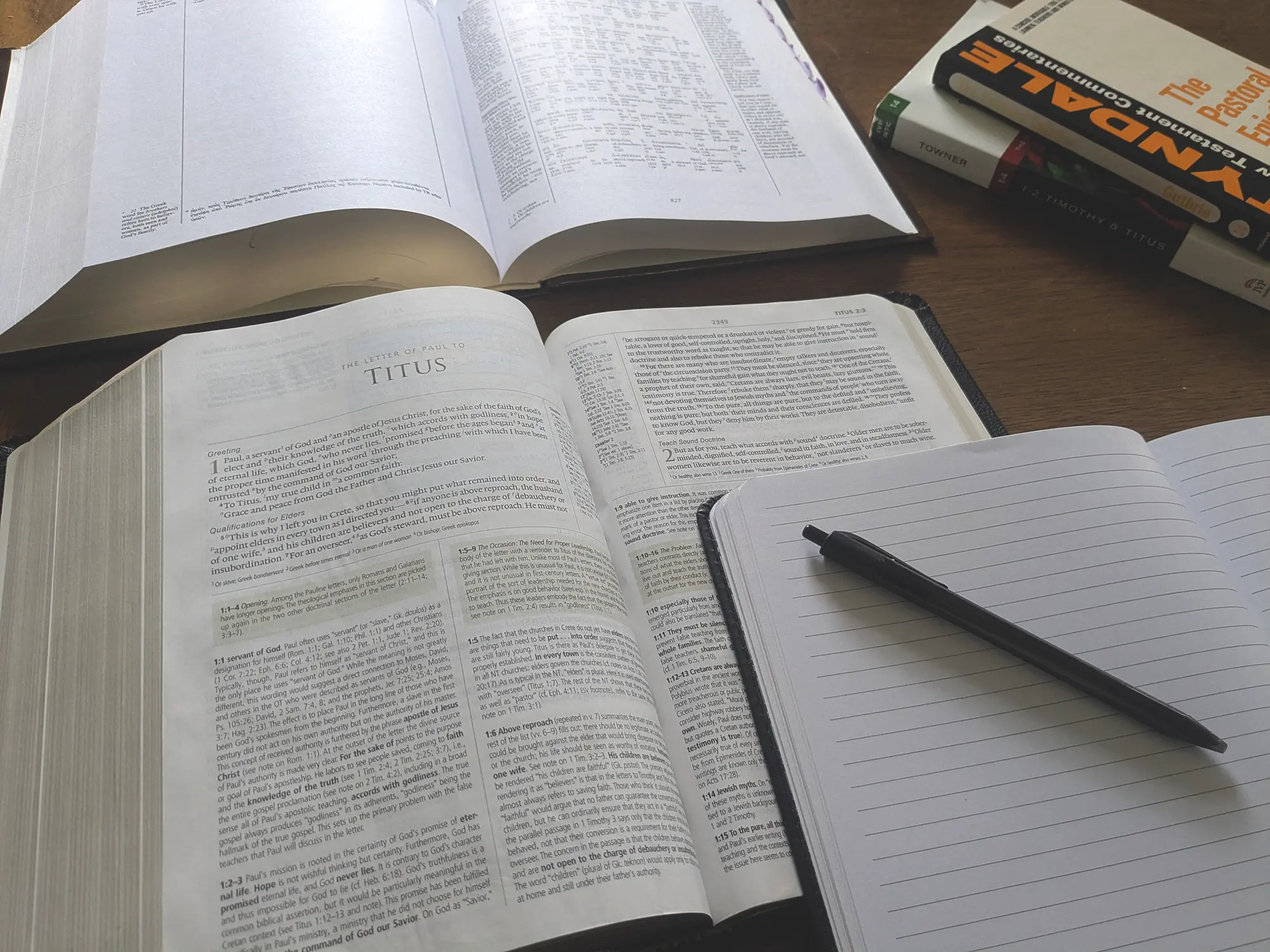
My plan was to have them study through Titus one verse at a time over their summer school break. Titus is particularly ideal for this project because not only does it have just 46 verses (and summer break is over 70 days), but also it has much to say about respect for authority, self-control, God’s grace, and good works.
I purchased two highly readable commentaries (Donald Guthrie’s volume in the Tyndale New Testament Commentaries series and Philip H. Towner’s work from the IVP New Testament Commentary Series). Then I gave the instructions below, taught the method to them, and reviewed and discussed their studies regularly.
- Read in context. The whole book (for shorter epistles) or 3-5 chapters, then the paragraphs around the verse of the day, then read the verse of the day several times.
- Study. Note key words and cross references. Rephrase the verse in your own words. Consult commentaries, and detail applications.
- Pray. Begin to apply what you’ve studied immediately in your prayers.
This one-page worksheet can be printed over and over to guide you or your counselee through an entire book, one verse at a time.
Bible Study Instructions
A Simple Method for Verse-by-Verse Bible Study
PART A. Every day:
- Read:
- Read the whole letter if possible. For longer books, read the 3-5 chapters surrounding
your current passage. - Slowly and meditatively, read the paragraph you are currently studying (3-10 verses).
- Read the verse you are studying that day 3-4 times.
- Read the whole letter if possible. For longer books, read the 3-5 chapters surrounding
- Write:
- Key words & phrases (1-3 per verse)
- What words/phrases are most important in this verse? What terms are repeated
in the chapter and/or book? Why are these important?
- What words/phrases are most important in this verse? What terms are repeated
- Cross references (1-3 per verse)
- In a study Bible, identify any cross-references (other verses in Scripture that
this verse quotes or alludes to), look them up, and read them. Note any
significant insights or connections these verses provide.
- In a study Bible, identify any cross-references (other verses in Scripture that
- Rephrase/Summarize
- Restate what the author is saying in this verse using your own words.
- Consult commentaries
- Read a Bible commentary on the verse you are studying, and write down a
summary of what the commentator says or quote any insights. - Always cite your sources! Use a simple format: Murray, Romans, p. 133.
- Read a Bible commentary on the verse you are studying, and write down a
- What should we learn from this? (choose at least one)
- Something to know about God (his character, promises)
- Something to know about ourselves (as sinners or saints)
- Something to believe (a doctrine or promise)
- How should we respond? (choose at least one)
- Something to do (a command to follow, a sin to avoid)
- Something to pray (a petition or thanksgiving)
- Something to sing (a praise, something to marvel at and rejoice in)
- Key words & phrases (1-3 per verse)
- Pray:
- Conclude your study by praying about what the passage says (see what you wrote for
“what we should learn” and “how we should respond,” above).
- Conclude your study by praying about what the passage says (see what you wrote for
PART B. After completing each chapter:
- Review the chapter. Take one day to complete the same steps as above in reference to the
chapter rather than the verse, making the following changes/additions:- Read the chapter 3-4 times.
- Review your previous written study notes.
- Fill out the worksheet with reference to the chapter as a whole.
- For “consult commentaries,” read the introductory/summary sections in the commentaries.
Tips on Choosing a Commentary
I highly recommend using a commentary when doing a verse-by-verse study. For beginners, this will help you grasp the sense of what you are reading. For those more familiar with the Bible, it will provide rich insights that will grow your appreciation for the Lord of Scripture.
While it is generally best to choose a commentary based on specific recommendations for each book rather than commentary series, there are many solid and genuinely helpful commentaries available. Here are some recommendations.
Affordable entry-level series:
- IVP New Testament Commentaries
- Tyndale Old Testament Commentaries
- Tyndale New Testament Commentaries
- The Bible Speaks Today Series
Free online commentaries:
- Matthew Henry’s Commentary on the Whole Bible
- John Gill’s Exposition of the Bible
- John Calvin’s Commentaries
- John Trapp’s Commentary on the Whole Bible
- Gospel Coalition Commentaries (modern)